Anthony Johnson Stratton was an American frontiersman and early pioneer to Utah.
Anthony Stratton was born in Nashville, Bedford County, in central Tennessee. His father and mother had New England forebears but they had followed the westering arc of many early nineteenth-century Americans. Stratton later moved to western Illinois where he affiliated with the Mormons, then joined them in their forced relocation to Utah Territory.
Journey to Utah
In 1845, he married a native of Kentucky, Martha Jane Layne. In 1849, they immigrated to Utah.
Pioneering in Provo in Utah County
In 1852, the Strattons moved fifty miles south to Utah Valley to the settlement of Provo on the Provo River above where it empties into Utah Lake. The Strattons joined a settlement that had been founded in 1850 so living conditions were still raw. The first inhabitants of Utah Valley constructed a fort for protection from Timpanogos Utes who frequented Utah Valley and Utah Lake. With their neighbors, the Strattons built cabins, cleared land, planted crops and tended their livestock.
In 1849-50, conflict erupted between Timpanogos Utes, whose traditional territory included Utah Lake, and the new settlers. In summer 1853, the Walker War erupted and the conflict was particularly intense in Utah County. Throughout the county, settlers abandoned exposed settlements, made fortifications, guarded settlements and livestock. During the 1849-50 conflict, Provo settlers had built Fort Utah. In the beginning of the Walker War, they determined that their walls were inadequate and each lot owner began constructing a higher and more substantial walls. Anthony Stratton would have assisted in some of these urgent activities. Perhaps the intensity of the Walker War conflict played a role in the Strattons' decision to relocate to the south, outside the traditional lands of the Ute Indians.
To Cedar City and the Ironworks
By 1854 the Strattons were in Cedar City in southern Utah. Stratton was listed as a lot owner in the early Cedar City land records in both Plat A and Plat B. Plat A was the temporary relocation site after they moved from the original fort. Plat B was a larger section of land located southeast of Plat A, at the base of the foothills. Modern Cedar City occupies all of Plat B and extends beyond it
There are several entries in the Deseret Iron Company ledger between 1856 and 1858 for Anthony Stratton. However, they are for very small transactions. He appears to have done little work directly or indirectly for the ironworks. Perhaps he was farming or raising livestock, two other vitally necessary occupations in the settlement.
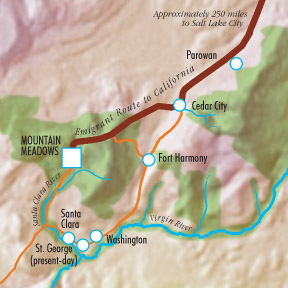
Map southern utah 1.jpgIn the Iron Military District: 2nd Lieutenant Anthony Stratton, Company E, Isaac Haight's 2nd Battalion
According to John D. Lee, Stratton arrived at Mountain Meadows sometime between Tuesday, September 8 and Thursday, September 10. He attended the militia council on Thursday evening.
His exact role in the massacre the following day is unknown. However, he may have been among the Cedar City militiamen who walked alongside the emigrant men as they marched from their wagon circle.
In 1858, Stratton helped build the road into the Virgin Valley. He was not listed in the 1859 arrest warrant but Lee identifies him in Mormonism Unveiled. In the late 1850s, Stratton and his family left Cedar City and moved to the southwest to Virgin. For the better part of the next two decades they lived in Kane or Washington counties.
In 1864, Stratton went east to act as a guide for some of the emigrant trains traveling west to Great Salt Lake City. He and his wife had eleven children, ten of whom survived to adulthood.
Relocating to Arizona
In 1877, Stratton accepted a call to help expand Mormon settlements in Arizona Territory. He and his family moved to Arizona and eventually settled in Snowflake on the upper Little Colorado River in Navajo County.
Final Years
He died in Snowflake in 1887. He was survived by his wife Martha and numerous children.
References
Alder and Brooks, History of Washington County, 50, fn. 13; FamilySearch.org; Huff, Utah County Centennial History, 42, 43; Jenson, Encyclopedic History of the Church, 683; Lee, Mormonism Unveiled 232, 380; Lee Trial transcripts; Shirts and Shirts, A Trial Furnace, 331, 478, 485, 495; Turley and Walker, Mountain Meadows Massacre: Jenson & Morris Collections, 236; Walker, et al, Massacre at Mountain Meadows, Appendix C, 263.
For full bibliographic information see Bibliography.
External Links
For further information on Anthony Johnson Stratton see: