The McMurdie family name is of Scottish origin but Samuel McMurdie was born in 1830 in the London borough of Lambeth in England, not far from the River Thames. He was born to Robert McMurdie (1798-1890) and Mary Ann Bill McMurdie (1801-1861). He is among the relative handful of early southern Utah settlers born and raised in or adjacent to an urban area.
Samuel McMurdie was baptized into the LDS Church in late 1851. Little is known of his early life before then.
Immigration to America and onto Utah
In 1853, McMurdie and his parents immigrated to Utah. Soon the McMurdie family moved to southern Utah. In the spring of 1857, the twenty-six-year-old McMurdie married fifteen-year-old Sarah Ann Kay of Lancashire, England. Theirs was one of many marriages in the era of the Mormon Reformation.
Working in the Iron Works
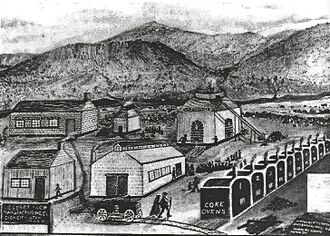
The records of the Deseret Iron Company reflect that in February 1856, McMurdie's account was credited for "herding." In the same month, his account (and many others) was debited a small amount ($.50) for "Indian depredations." McMurdie seems not to have been among the skilled "iron men." But he did perform work that directly benefited the ironworks. In 1857, using his wagon and team, McMurdie hauled coal or wood to the foundry. His account was credited on July 20 and 27, August 3 and 17, and September 3 (the latter entry was on the eve of the events in Cedar City leading to the massacre at Mountain Meadows).
At the time, many others were hauling coal as well as coke, wood, limestone and iron ore, while others were tending the furnace, indicating that they had been charging the furnace for one or more trial runs.
On September 10, McMurdie's and many other accounts were debited a small amount to pay county taxes, a periodic charge. Then the records are silent until September 29, a lacunae of two and one-half weeks in the records. The ironworks and all activities associated with it had come to a complete halt. Since there is no other similar gap in the records of the Deseret Iron Company for this period, that is some indication, albeit indirect, of the disruption to the sense of normalcy in Cedar City caused by the massacre and its reverberations.
In the Iron Military District: Sergeant Samuel McMurdie, Company E, Isaac Haight's 2nd Battalion
During 1857, 26-year-old Samule McMurdie was a sergeant in a platoon in Company E in Cedar City. Anthony Stratton was 2nd Lt. of that platoon and Samuel Jewkes was a private in the same platoon. Captain Elias Morris was at the head of Company E which was attached to Major Isaac C. Haight's 2nd Battalion. John Macfarlane was Haight's adjutant.
Sometime between the first attack on September 7th and final massacre on the 11th, Samuel McMurdie was among a contingent ordered from Cedar City to the Mountain Meadows. On the morning of the massacre, he and Samuel Knight drive their respective wagons to the emigrant wagon circle. Hours later, they transported young children and wounded away from the wagon circle. Leading their wagons was John D. Lee.
Although many participants from Cedar City were named in the 1859 arrest warrant, neither Bishop Philip Klingensmith nor his counselor McMurdie were listed, leading some to conjecture that one of them may have been among Judge John Cradlebaugh's anonymous sources in his 1859 investigation.
Later Life
In May and June 1858, McMurdie was again hauling coal to the foundry. At the time there was much activity at the ironworks as they made their last attempts to produce a reliable and profitable iron operation. The last mention of McMurdie in these records was on October 18, 1858.
In 1859, the McMurdie family and many others abandoned Cedar City. The principal reasons were the failure of the ironworks, the general pall cast over the community by the disastrous massacre, and Judge John Cradlebaugh's criminal investigation of the massacre resulting in an arrest warrant naming many Cedar City militiamen.
The McMurdies moved to Cache Valley in the far north of Utah Territory. Between 1859 and 1862, McMurdie briefly had a polygamous wife, Mary Jane Jenkins (1845-1919), but there were no children from this marriage and they later divorced.
During the Lee trials of 1875-76, McMurdie was called to testify in the second trial. He testified concerning the actions of John D. Lee during the events leading to the massacre. When cross-examined about whether he had shot any of the emigrants, McMurdie exercised his privilege against self-incrimination.
However, in Lee's autobiography, Mormonism Unveiled: The Confessions of John D. Lee, Lee claimed that McMurdie dismounted from his wagon with his shotgun, went to the second wagon and fired on the injured adults in the wagon. William Bishop, Lee' principal attorney in the second trial, listed McMurdie as "[a]ssisted in killing wounded" in Bishop's "List of Assassins" appended to Mormonism Unveiled.
The extent of McMurdie's extant written statements about the massacre are limited to those contained in his 1876 trial testimony.
Life in Cache Valley
McMurdie, his wife Sarah and their children spent five years in Wellsville before settling on twelve acres near Paradise. One source states that McMurdie brought wagons, tools and bolts of cloth he obtained at Mountain Meadows to Cache Valley. One acquaintance reported the McMurdie had his hired man burn the wagons because they still bore the holes from gunfire during the first attack and siege. He carried a lingering concern that he might be prosecuted for his role in the massacre.
However, McMurdie was also extremely ambitious. He expanded his land holdings and established a creamery and sawmill. Around 1885, he mortgaged his property to invest in imported purebred stock, a practice familiar to him from his British homeland. By the mid-1890s, his Diamond M Creamery was among the largest and most advanced in Cache Valley. For years McMurdie was prosperous.
But by 1905, McMurdie was seriously overextended during times of economic decline. He sold off most of the property and he and his wife were left with their home and original twelve acres.
Final Years
McMurdie's wife, Sarah, died in 1917 and McMurdie died five years later at the age of 93. They had spent nearly sixty years in Cache Valley. They had thirteen children, ten of whom survived to maturity.
The McMurdie-White Farmstead
Much of the McMurdie farm operation, now called the McMurdie-White Farmstead, still stands. In 2005, it was listed on the National Registry of Historic Places.
References
Bigler and Bagley, Innocent Blood: Essential Narratives of the Mountain Meadows Massacre, 347-48, 394, 396; Fielding, ed., The Tribune Reports on the Trial of John D. Lee; Lee, Mormonism Unveiled, 232, 238, 241, 242, 243, 252, 380; Lee Trial transcripts; New.FamilySearch.org; Ricks and Cooley, ed., The History of a Valley: Cache Valley, Utah-Idaho, 38n, 275, ; Shirts and Shirts, A Trial Furnace, 484, 495; Walker, et al, Massacre at Mountain Meadows, Appendix C; Willie, "History of Dairying in Cache Valley," in Alder, ed. Cache Valley: Essays on Her Past and People, 54.