Anthony Johnson Stratton was an American frontiersman and early pioneer to Utah.
Anthony Stratton was born in Nashville, Bedford County, in central Tennessee. His father and mother had New England forebears but they had followed the westering arc of many early nineteenth-century Americans. Stratton later moved to western Illinois where he affiliated with the Mormons, then joined them in their forced relocation to Utah Territory.
Journey to Utah
In 1845, he married a native of Kentucky, Martha Jane Layne. In 1849, they immigrated to Utah.
Pioneering in Provo in Utah County
In 1852, the Strattons moved fifty miles south to Utah Valley to the settlement of Provo on the Provo River above where it empties into Utah Lake. The Strattons joined a settlement that had been founded in 1850 so living conditions were still raw. The first inhabitants of Utah Valley constructed a fort for protection from Timpanogos Utes who frequented Utah Valley and Utah Lake. With their neighbors, the Strattons built cabins, cleared land, planted crops and tended their livestock.
In 1849-50, conflict erupted between Timpanogos Utes, whose traditional territory included Utah Lake, and the new settlers. In summer 1853, the Walker War erupted and the conflict was particularly intense in Utah County. Throughout the county, settlers abandoned exposed settlements, made fortifications, guarded settlements and livestock. During the 1849-50 conflict, Provo settlers had built Fort Utah. In the beginning of the Walker War, they determined that their walls were inadequate and each lot owner began constructing a higher and more substantial walls. Anthony Stratton would have assisted in some of these urgent activities. Perhaps the intensity of the Walker War conflict played a role in the Strattons' decision to relocate to the south, outside the traditional lands of the Ute Indians.
Sketch - Iron works.jpg
To Cedar City and the Ironworks
By 1854 the Strattons were in Cedar City in southern Utah. Stratton was listed as a lot owner in the early Cedar City land records in both Plat A and Plat B. Plat A was the temporary relocation site after they moved from the original fort. Plat B was a larger section of land located southeast of Plat A, at the base of the foothills. Modern Cedar City occupies all of Plat B and extends beyond it.
In moving to Cedar City, Anthony J. Stratton was settling in an area dominated by the Deseret Iron Company, known more familiarly as the Ironworks.
After iron ore and coal deposits were discovered in the region, Cedar City was founded. In the first years of 1851-52, they investigated whether the region had the necessary raw materials – iron ore, limestone, wood, coal, and waterpower – to support smelting on a large scale. After confirming the presence of the necessary materials and relying heavily on the British Isles immigrants who had worked in iron-related industries in Great Britain, they set to building an iron manufacturing plant. They sited the ironworks at the mouth of Coal Creek near the present location of Cedar City. They mined the coal up canyon and transported it by team and wagon to the furnace located on the stream bank below the mouth of the canyon. The iron ore was transported from nearby Iron Springs by wagon. In 1852, after a small test furnace produced a low quality pig iron, they set about building a full-scale blast furnace.
Progress was impeded, however, in 1853-54 during the Walker War. They shifted their energies from iron making to “forting up” to increase their safety. After a peace treaty was reached with the Ute chief Wakara in 1854, they returned to improving the ironworks. By 1855, they had achieved their greatest success with a sustained run of the furnace producing several tons of pig iron. But most of the runs both before and after failed to achieve a sustained run producing good quality iron. One problem was the fickle nature of Coal Creek, which continued to alternate between flooding and droughts. They determined to develop a more dependable source of power.
In April 1857, the delivery of a new steam engine from Great Salt Lake City seemed to provide the answer. After its arrival, they built a new room to house the engine, connected its boiler to a steady water supply and modified the furnace to accommodate the engine.
In early June they started an iron run using the steam engine. However, the new machinery created its own set of problems. Through the end of July, they experimented with different configurations of furnace, engine and piping, attempting to optimize the blast furnace.
From late April through July, those working up the canyon in mining or hauling wood, coal, limestone, rock, sand or “adobies” to the ironworks were Isaac C. Haight, James Williamson, George Hunter, Joseph H. Smith, Ira Allen, Ellott Wilden, Swen Jacobs, Alex Loveridge, Joel White, Ezra Curtis, Samuel McMurdie, Samuel Pollock, John Jacobs, John M. Higbee, John M. Macfarlane, Samuel Jewkes, Nephi Johnson, Thomas Cartwright, William Bateman, Elias Morris, Benjamin Arthur, Joseph H. Smith, Robert Wiley, and Philip Klingensmith. Those working at the ironworks on the furnace, engine, coke ovens or blacksmith shop included Elias Morris, John Humphries, Ira Allen, John Urie, Benjamin Arthur, James Williamson, Joseph H. Smith, Samuel Jewkes, Joseph Clews, Richard Harrison, William C. Stewart, William Bateman, John M Macfarlane, John M. Higbee, John Jacobs, George Hunter, Samuel Pollock, William S. Riggs, Alex Loveridge, Ellott Wilden, Ezra Curtis, Eliezar Edwards, Swen Jacobs, Joel White, and Thomas Cartwright. (The two lists overlap because some worked both in the canyon and at the Ironworks.) Other prominent figures at the ironworks who were not later involved at Mountain Meadows were Samuel Leigh, George Horton, James H. Haslem, Laban Morrell, John Chatterley, Thomas Gower, Thomas Crowther and others.
By the time reports reached them in early August of a threatened “invasion” of U.S. troops into Utah, they had decided on further changes to the ironworks. They determined that a reservoir was necessary so as to provide a steady supply of filtered water to the steam engine. Immediately, they set to work, digging, lining and filling the reservoir. From late August to early September, shortly before the crisis involving the passing Arkansas emigrant company, they began a new furnace run. But it, too, ended in failure, probably around the time that a dispute arose between some community members and several of those in the passing Arkansas wagon train.
Although Anthony Stratton was in Cedar City at this time, he is one of the few settlers who had not been working in the Ironworks before being sent to Mountain Meadows. There are several entries in the Deseret Iron Company ledger between 1856 and 1858 for Anthony Stratton. However, they are for very small transactions. Further, the only transactions in mid-1857 involve a donation that he and other community members made in May for "Land & the Indians" and several purchases of foodstuffs from the company store in June. He appears to have done little work directly or indirectly for the ironworks. Perhaps he was farming or raising livestock, two other vitally necessary occupations in the settlement.
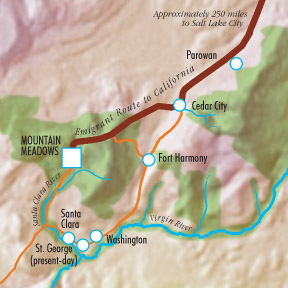
Map southern utah 1.jpgIn the Iron Military District: 2nd Lieutenant Anthony Stratton, Company E, Isaac Haight's 2nd Battalion
According to John D. Lee, Stratton arrived at Mountain Meadows sometime between Tuesday, September 8 and Thursday, September 10.
On Thursday evening, according to Lee, Stratton and many others from Cedar City attended the war council held on the grounds of Mountain Meadows.
On Friday, September 11, many members of the militia contingent from Cedar City acted as guards alongside the emigrant men as they marched northward from their fortified position inside the wagon circle. As the massacre commenced, the duty of the guards was to wheel and fire on the emigrant men, quickly dispatching them. Yet during the actual massacre, reactions varied among the guards. Some shrank from their duty, others fired over the heads of their victims, while others still undertook their bloody duty with zeal. Within minutes, members of the Cedar City unit had killed all but three of the emigrant men. However, whether Stratton was in this guard unit and if so, how he acted during the massacre will probably never be known with any certainty.
In 1858, Stratton helped build the road into the Virgin Valley. He was not listed in the 1859 arrest warrant but Lee identifies him in Mormonism Unveiled. In the late 1850s, Stratton and his family left Cedar City and moved to the southwest to Virgin. For the better part of the next two decades they lived in Kane or Washington counties.
In 1864, Stratton went east to act as a guide for some of the emigrant trains traveling west to Great Salt Lake City. He and his wife had eleven children, ten of whom survived to adulthood.
Relocating to Arizona
In 1877, Stratton accepted a call to help expand Mormon settlements in Arizona Territory. He and his family moved to Arizona and eventually settled in Snowflake on the upper Little Colorado River in Navajo County.
Final Years
He died in Snowflake in 1887. He was survived by his wife Martha and numerous children.
References
Alder and Brooks, History of Washington County, 50, fn. 13; FamilySearch.org; Huff, Utah County Centennial History, 42, 43; Jenson, Encyclopedic History of the Church, 683; Lee, Mormonism Unveiled 232, 380; Lee Trial transcripts; Shirts and Shirts, A Trial Furnace, 331, 478, 485, 495; Turley and Walker, Mountain Meadows Massacre: Jenson & Morris Collections, 236; Walker, et al, Massacre at Mountain Meadows, Appendix C, 263.
For full bibliographic information see Bibliography.
External Links
For further information on Anthony Johnson Stratton see: